
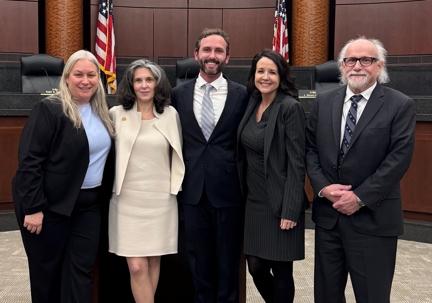
When someone is arrested, the first court appearance can shape everything that follows. At a bond hearing, a judge decides whether a person will be released or remain in jail, sometimes for weeks or months, before their case is ever resolved. For indigent defendants or someone who cannot afford to hire their own defense counsel, that decision is often made without a lawyer present. That reality is at the center of a significant federal case recently argued before the 8th U.S. Circuit Court of Appeals by Attorney Doug Norwood and Attorney Alison Lee of Norwood & Norwood, P.A.
This case challenges a long-standing practice in Benton County District Court that allowed bond hearings to move forward even when defendants were found to be indigent and had no attorney appointed to represent them. The question before the court is straightforward but profound: Does the Constitution require that a lawyer be present at a defendant’s first appearance bond hearing?
A federal district court already answered that question in the affirmative. In August 2024, U.S. District Judge Timothy L. Brooks ruled that indigent defendants have a constitutional right to legal representation beginning at their first appearance bond hearings. He ordered that public defenders must be present when bail is determined in Judge A.J. Anglin’s court. The State of Arkansas appealed that decision, bringing the case to the 8th Circuit.
Attorneys Doug Norwood and Alison Lee filed this lawsuit on behalf of two Benton County defendants who were arrested on felony charges, found to be indigent, and required to attend bond hearings without counsel. Both spent time in jail as a result. Their case highlights why these hearings matter so deeply. A bond decision determines whether someone keeps their job, remains with their family, and is able to participate meaningfully in their own defense, or sits in jail simply because they could not afford a lawyer at the earliest stage of the process.
During oral arguments, the state contended that bond hearings are not a “critical stage” of a criminal case. But the reality is that these hearings aren’t neutral or consequence-free. Prosecutors describe the alleged offense, discuss criminal history, and recommend bond amounts. Defendants are often asked questions without guidance from counsel, creating a real risk of self-incrimination. And if bond is denied or set too high, a person may remain jailed for 30 to 60 days before bond can even be revisited.
That is why this case should matter, not only to the named plaintiffs but to anyone who believes constitutional rights should apply from the very first courtroom appearance. It is also why it is so significant that two attorneys from our firm argued this issue before a federal appellate court. Appearing before the 8th Circuit is not routine litigation. It reflects the seriousness of the constitutional questions involved and the level of legal knowledge and experience required to address them.
At Norwood & Norwood, P.A. in Northwest Arkansas, we have handled more than 35,000 criminal cases and secured over 25,000 charge dismissals and not guilty verdicts. But this case is about more than numbers. It is about protecting fundamental rights at the moment they matter most and when your freedom is first on the line.
To learn more about this case, you can click here to view the full Northwest Arkansas Democrat-Gazette article. (Log-in or subscription may be required.) You can also visit our blog often for any important updates that we will share there. If you need a criminal defense team in Arkansas with former prosecutors and more than 100 years of combined practice experience, you can call (479) 235-4600 to schedule a free consultation at one of our law offices.